By Protopian
Methicillin-resistant Staphylococcus aureus survives many β-lactam antibiotics by continuing to build its cell wall after those drugs have disabled the bacterium’s ordinary penicillin-binding proteins. Its substitute, PBP2a, is one of the molecular reasons MRSA became MRSA in the first place.
Researchers led by Gabriel Torrens and Felipe Cava at Umeå University have now identified a second dependency inside that defence. Their study, published in Nature Communications in July 2026, found that MRSA strains which regain high-level β-lactam resistance through mutations in a signalling gene called gdpP become unusually vulnerable when bacteria are deprived of undecaprenyl phosphate, or C55-P — an essential lipid carrier used to ferry cell-wall building blocks across the membrane.
C55-P is not an optional accessory. It carries peptidoglycan precursors through the bacterial membrane so they can be assembled into the rigid mesh surrounding the cell. When that carrier pool is depleted, cell-wall construction begins to fail.
The Umeå group reached this vulnerability by studying evolution rather than simply screening for another antibiotic.
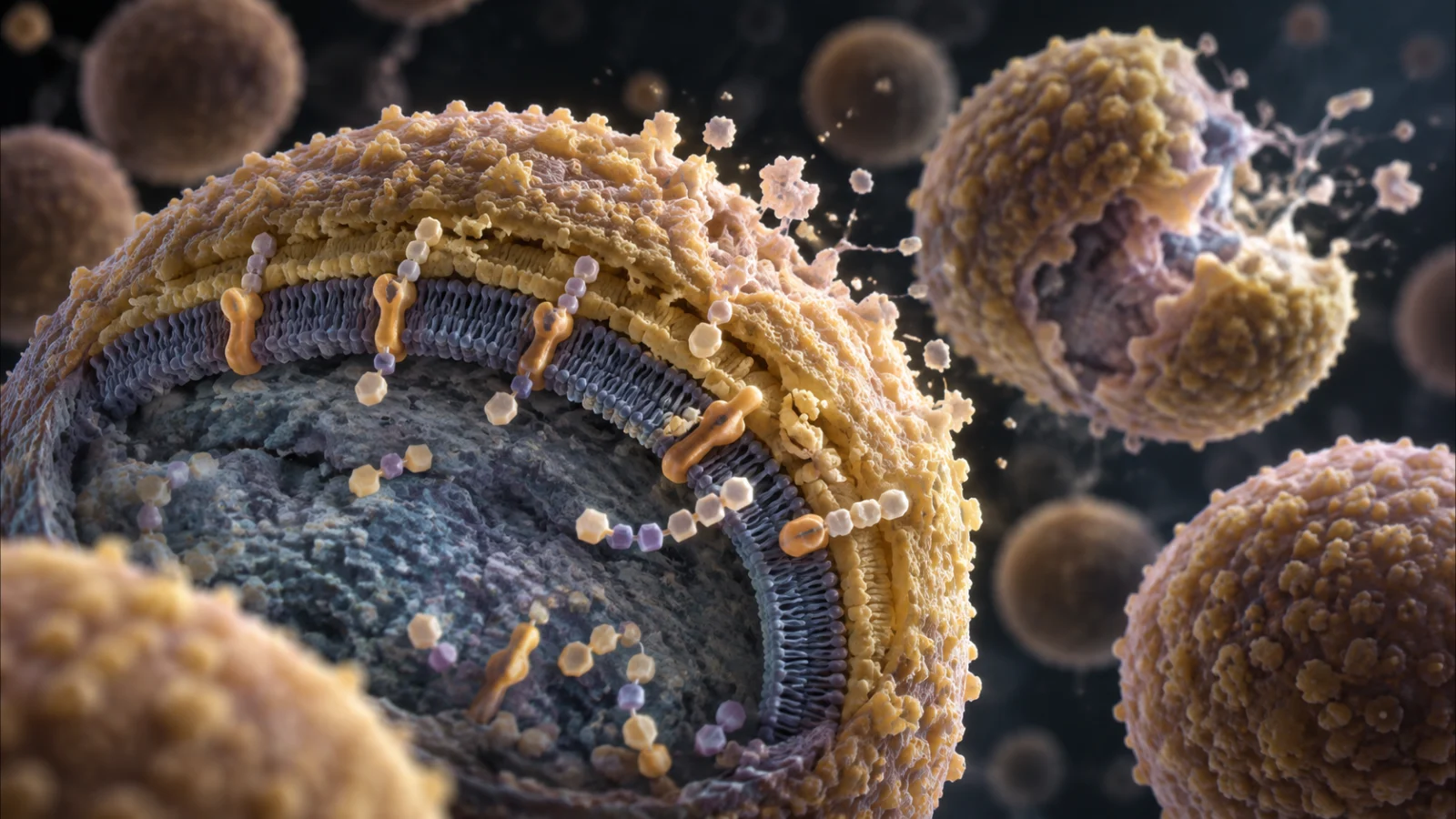
MRSA’s PBP2a works in specialised regions of the membrane rich in the golden pigment staphyloxanthin. Earlier work had shown that disrupting those membrane regions can interfere with PBP2a and restore some β-lactam susceptibility. Torrens and colleagues therefore asked the less convenient question: what happens when the bacteria evolve around that attack?
Across laboratory evolution experiments lasting up to roughly 200 generations, mutations in gdpP repeatedly emerged as an important route back to oxacillin resistance. gdpP encodes an enzyme involved in controlling the signalling molecule cyclic di-AMP, which regulates aspects of bacterial ion balance and cell-wall physiology. Deleting gdpP in one MRSA background raised the oxacillin minimum inhibitory concentration to about 256 micrograms per millilitre, confirming that the mutation could support very high resistance.
The escape, however, came with a dependency.
The researchers compared two compounds that interfere with bacterial isoprenoid metabolism: zaragozic acid and simvastatin. Both disturbed the membrane environment used by PBP2a, but simvastatin acted further upstream in the mevalonate pathway. That mattered because the same pathway also supplies precursors needed to make C55-P.
Measurements showed that simvastatin drove both farnesyl pyrophosphate and C55-P below the experiment’s detection limit, while zaragozic acid did not. In the gdpP-deficient bacteria, that depletion amplified an existing shortage of peptidoglycan precursors and restored oxacillin susceptibility. Drugs that attack the lipid-carrier system more directly, including bacitracin and amphomycin, produced similar effects.
This is the useful result: a mutation that helps bacteria solve one resistance problem can increase their dependence on another part of the cell-wall system.
The effect was not absolute. The researchers deliberately selected further suppressor mutants capable of growing despite oxacillin and simvastatin. These carried additional changes in RNA-polymerase genes such as rpoB and rpoC, and in some cases in oatA, which alters peptidoglycan turnover. Those mutations could partly restore resistance even when C55-P metabolism was stressed.
But that second escape route appeared costly.
In mouse bone-marrow-derived macrophages, the highly resistant gdpP mutant remained damaging under oxacillin treatment, while adding simvastatin reversed much of that advantage. In a separate intranasal mouse infection experiment, the evolved mutant strains established substantially lower bacterial burdens in the lungs than the parental wild-type strain; one suppressor was nearly cleared. Several mutants also formed less biofilm.
That is the evolutionary trap the study is trying to construct: force the bacterium into a resistance mechanism that exposes another weakness, then make the next escape costly enough to reduce its ability to cause disease.
The team also found a related effect in Streptococcus pneumoniae. Removing two phosphodiesterases involved in cyclic di-AMP metabolism increased β-lactam resistance, but stressing C55-P metabolism again made those bacteria more vulnerable. That does not establish that the same treatment will work across Gram-positive pathogens, but it suggests the dependency is not peculiar to a single MRSA strain.
The awkward part is simvastatin itself.
A separate 2026 study by Zoha Sohail, Henry Claireaux, Andrew Edwards and Edward Douglas at Imperial College London examined eight commonly prescribed non-antibiotic drugs against MRSA. It also found that simvastatin disrupts the bacterial mevalonate pathway and cell-wall synthesis. But in their checkerboard experiments, simvastatin antagonised oxacillin rather than helping it: in one MRSA strain, sub-inhibitory simvastatin increased the oxacillin MIC fourfold. The same study also found antagonism between simvastatin and vancomycin under some conditions.
That is not a trivial contradiction.
The Umeå experiments found especially strong synergy in bacteria whose resistance had been routed through gdpP disruption and associated cell-wall stress. The Imperial group tested broader drug interactions in different bacterial backgrounds and observed the opposite outcome. Their paper explicitly noted that its result conflicted with earlier reports of β-lactam synergy.
The sensible conclusion is therefore not that simvastatin is an antibiotic waiting to be repurposed.
It is that the effect depends strongly on bacterial genotype, physiological state, drug concentration and experimental context. A compound can expose a useful synthetic-lethal interaction in one resistance state and blunt an antibiotic in another.
There is another practical constraint. The antibacterial concentrations used in laboratory studies of simvastatin are far above those for which the drug was designed. The Umeå work commonly used tens of micromolar simvastatin in mechanistic experiments, including 25 micromolar in some infection assays and 100 micromolar during suppressor selection. Earlier microbiological studies likewise found direct anti-S. aureus activity only at concentrations in the tens of micrograms per millilitre.
That makes ordinary cholesterol-lowering therapy an implausible shortcut to treating MRSA.
The more interesting therapeutic target is the bacterial dependency itself: C55-P synthesis, recycling or utilisation. Bacitracin already attacks this part of cell-wall metabolism, but toxicity restricts its systemic use. The new work suggests that safer, more selective inhibitors of the same bottleneck could potentially act as β-lactam adjuvants — particularly against resistance states that have become dependent on elevated cyclic di-AMP signalling or altered peptidoglycan metabolism.
That remains a research programme rather than a treatment.
The study used laboratory evolution, engineered mutants, defined bacterial strains, cultured macrophages and a small mouse infection model. It did not demonstrate successful treatment of human MRSA infection, establish a clinically useful dose of a C55-P inhibitor, or show that ordinary clinical isolates will reliably evolve into the same exploitable state. The existence of alternative suppressor mutations is itself evidence that bacteria are not confined to one escape route.
Still, the conceptual shift is useful. Antibiotic resistance is often described as if evolution steadily equips bacteria with more armour. This work shows a less tidy reality: solving one biochemical problem can deepen dependence on another system.
If that dependency can be predicted, detected and safely targeted, resistance may sometimes be turned from an endpoint into a constraint.
Sources
phys.org — Cell wall transport disruption exposes weakness in antibiotic-resistant bacteria